
The project concept and the process is under the Non-Disclosure Agreement (NDA). I have used dummy data on all of the screens to protect the confidentiality of the content. All the work belongs to the respective companies and should not be copied or recreated in any manner.

B2B Telecom App
Overview
A telecom specific CRM solution dedicated to serve telcos that handle B2B flows across all stages from contract creation to order fulfilment.
Designed a telecom-specific CRM solution tailored for B2B service providers, enabling seamless management of enterprise customer journeys from initial contract creation through to order fulfilment. The platform was built to support complex telco workflows, ensuring operational efficiency and scalability for large-scale business clients.
Team Member
Team of 1 UX principal designer & 2 UX specialists, 1 UI Specialist.
My Role
-
Collaborated closely with cross-functional stakeholders to gather business and user requirements.
-
Led the end-to-end UX process from research and journey mapping to wireframes, prototypes, and final UI design.
-
Advocated for user-centric design decisions while aligning with technical constraints and business goals.
-
Delivered a cohesive experience that streamlined B2B operations and improved user efficiency across the CRM lifecycle.
My Involvement
3 years, 5 months
Tools Used
Figma, Miro, Sketch, Axure
The Challenge
The Scope & Approach
Enterprise telecommunications sales processes are complex due to multiple approval stages, extensive product catalogs, complex pricing structures, long sales cycles and fragmented systems. As understood from the initial research done by dedicated team.
The project was initiated with a focus on the contract creation flow, laying the foundation for a modular, scalable design system. As the platform matured, we expanded the experience to include the order creation and fulfilment processes, ensuring continuity and coherence across all user touchpoints.
User Personas
The major personas identified are Product Operation Agent, Order Operation Agent, Sales Manager & Sales Director.


B2B Lifecycle
The B2B lifecycle begins with lead generation and proactive relationship management. Once contracts are finalized, orders are formally processed, followed by a streamlined fulfillment phase that ensures the timely delivery of products or services to close the transaction cycle.

My Contribution
Evolving the B2B Telecom Modification Flow
The 'modify' flow is a critical component of the Lead-to-Contract stage, empowering users to seamlessly update and revise existing customer-signed agreements.
Initially, we designed a multi-step, non-linear contract creation flow. We built flexibility into the proposal stage, allowing customers to request adjustments to offers and attributes via their sales agent. To smoothly handle any changes requested after a contract is already generated, we implemented a dedicated 'modify' flow.

Phase 1 - The Baseline - Simple Linear Flow
The Challenge
The platform lacked post-signature flexibility. Once a contract was finalized, it was locked. This forced agents to recreate proposals from scratch for even the simplest revisions, leading to significant inefficiencies. My goal was to introduce a 'Modify' flow that empowered agents to make updates quickly and intuitively, while maintaining strict version control and compliance.
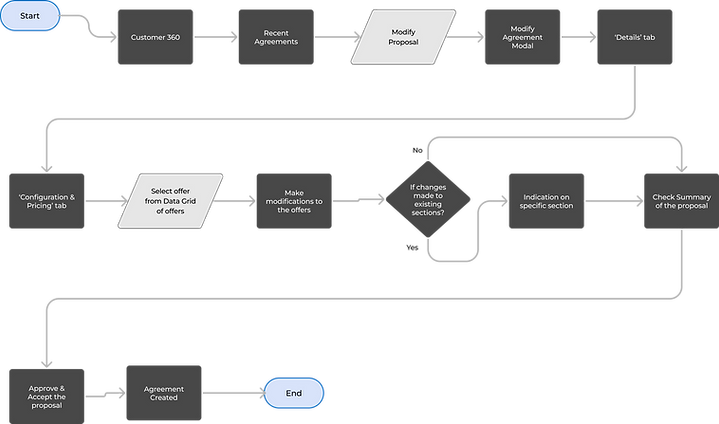
User Flow Mapping
Architected a comprehensive user flow that pinpointed how 'Modify' actions ripple through the system, ensuring design decisions proactively mitigated downstream risks.
Outcome
Led whiteboarding workshops to deconstruct the legacy proposal process, mapping existing pain points and identifying critical dependencies.
Managed design reviews with cross-functional stakeholders and domain experts to gain consensus, bridging the gap between technical constraints and user experience before initiating the high-fidelity wireframing phase.


Phase 2 - Location Based Complexity
The Challenge
Phase 1 successfully solved the friction of modifying simple Wireless offers. However, Phase 2 introduced Business Internet and Data Connectivity products, which brought a new layer of complexity: location-based assignments. The challenge was to evolve the existing 'Modify' flow to handle geographic dependencies without overwhelming the user. I needed to design an intuitive way for agents to modify location-specific offers while maintaining consistency across the rest of the proposal.
User Flow Mapping
To support the introduction of Business Internet and Data Connectivity products, I expanded the existing modification flow to handle multi-site requirements. The design centers on a tab-based navigation architecture that separates general proposal details from complex, location-specific configurations.

Outcome
Translating Logic into Layout
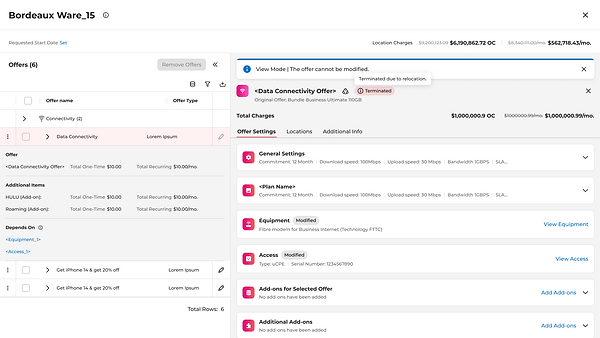
Mapping the 'Configuration & Pricing' and 'Location Offers' nodes from the user flow into intuitive UI layouts that support complex, multi-site editing.
Stakeholder Alignment:
Leveraging insights from our review sessions to ensure that technical constraints (such as serviceability checks) were accounted for within the wireframe architecture.
Prioritizing Cognitive Load:
Simplifying the interface to ensure that agents could navigate through tabs, such as 'Details', 'Configuration', and 'Approval', without losing track of their progress during multi-step modifications.


Phase 3 - Dynamic Updates
The Challenge
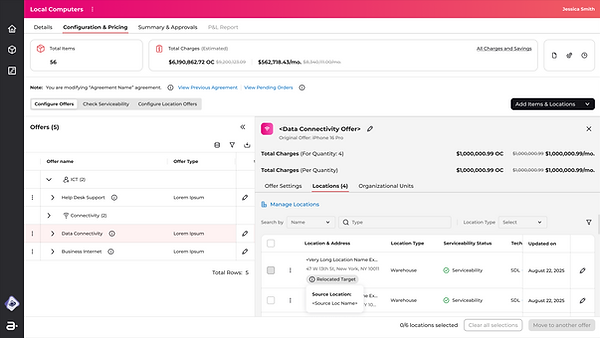
Having established a robust foundation for modifying existing contracts, the next hurdle was unlocking true flexibility: offer relocation. Business Internet and Data Connectivity clients frequently shift operations, yet our system treated these offers as locked to their original locations. This created significant friction for agents who needed to move services without restarting the entire proposal process. I was tasked with designing a fluid relocation flow that allowed agents to "lift and shift" offers across sites instantly, preserving the underlying commercial terms.
User Flow Mapping
To support the introduction of Business Internet and Data Connectivity products, I expanded the existing modification flow to handle multi-site requirements. The design centers on a tab-based navigation architecture that separates general proposal details from complex, location-specific configurations.

Outcome : Accelerating Iteration via AI-Assisted Prototyping
I enhanced the 'Modify' flow to include a seamless relocation mechanism, accounting for complex inter-location offer dependencies. Leveraging Figma AI (Figma Make), I accelerated the design process by mapping out core flows and complex edge cases early. The use of AI-generated prototypes for stakeholder validation sessions enabled us to identify potential friction points immediately, allowing for iterative improvements that resulted in a highly polished and efficient final user experience.

Key Takeaways
Enhanced Decision Support
The new tab-based architecture and 'Impact View' provided agents with the clarity needed to make complex, multi-site changes with confidence.
Scalable Architecture
The design successfully supported the onboarding of new LOBs (Business Internet, Data Connectivity, Mobility, Help & Support etc) without requiring a complete overhaul of the existing interface, proving the system’s long-term viability.
Faster Design Cycles
By leveraging AI-assisted prototyping for early stakeholder validation, we reduced the design-to-development feedback loop comparatively, allowing for quicker implementation of complex features.
B2B - amAIz
To streamline the modification of complex agreements, I integrated amAIz, the B2B platform's copilot—directly into the 'Modify' workflow. Working closely with domain experts, I designed an interface that offloads cognitive burdens from the agent to the AI. Starting with core capabilities, this integration serves as a foundation for a long-term roadmap that will eventually enable amAIz to execute complex, multi-step contract revisions independently.


